Be first to know
Keep up to date with ecommerce news, trends and articles. Brought to you by Stock2Shop.
Sign up todayWhy “owning the code” often costs more than you expect
When organisations evaluate integration options between their ERP, ecommerce platforms, marketplaces and internal systems, a familiar argument often emerges:
Why should we pay a monthly integration fee when we can build it ourselves once and own it?
On the surface, the logic feels sound. A once-off capital investment appears easier to justify than an ongoing operating expense. Ownership sounds attractive. Control feels reassuring.
But in practice, companies that choose to build their own integrations almost always underestimate the true, long-term cost — financially, operationally and strategically.
Integrations are not static assets. They are living systems that require continuous maintenance, specialist expertise and ongoing adaptation as your business, volumes and technology stack evolve. When these realities are fully accounted for, the economics often favour using a proven integration platform like Stock2Shop.
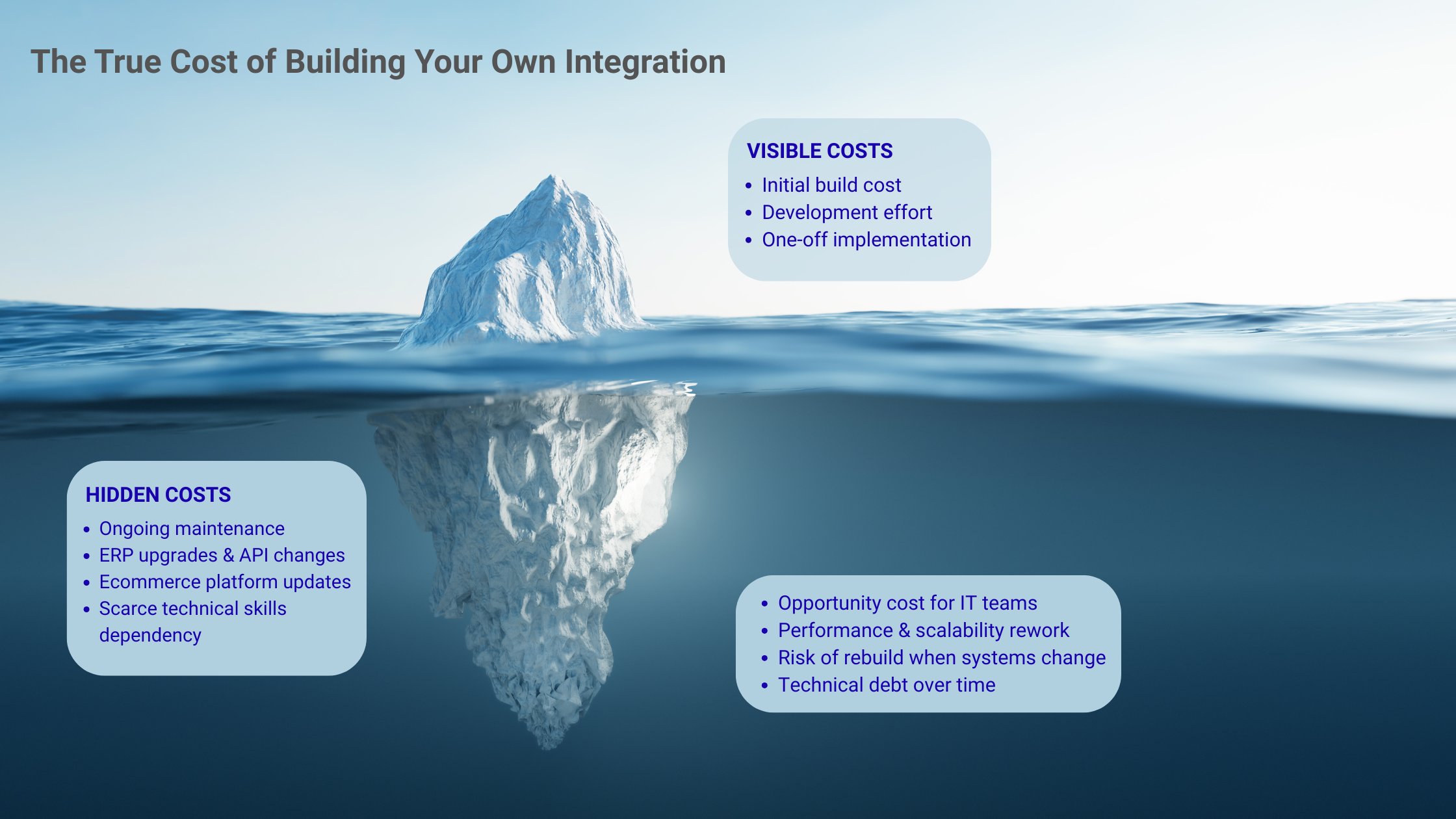
The true cost of building a custom integration includes not only the initial development effort, but also ongoing maintenance, dependency on scarce technical skills, opportunity cost for internal teams, and the risk of rebuilding when systems or platforms change. Over a 3–5 year period, these costs often exceed the predictable monthly cost of a managed integration platform.
1. Initial build costs are only the starting line
Custom integrations rarely stop at “just connecting systems”.
Even a basic ERP-to-ecommerce integration typically requires:
What begins as a “simple sync” often becomes a multi-month project, whether built internally or outsourced. These costs are usually capitalised — but they represent only the first phase of the integration’s lifecycle.
2. Ongoing maintenance is not optional
Once an integration goes live, maintenance starts immediately.
Common triggers include:
Each of these creates ongoing technical cost and delivery risk.
3. Dependency on Scarce Technical Skills
Custom integrations concentrate knowledge in people, not systems.
Over time, organisations become dependent on:
When key individuals leave, undocumented integrations become expensive — or impossible — to maintain. Replacing this knowledge often costs more than the original build.
By contrast, specialised integration providers retain institutional knowledge across multiple customers, ERP systems and ecommerce platforms, reducing reliance on individual contributors.
4. Opportunity Cost for Your IT Team
Every hour spent maintaining bespoke integrations is an hour not spent on:
Integration infrastructure rarely differentiates a business, yet it consumes a disproportionate share of technical time when managed internally.
5. Overcapitalising on a Short-Lived Asset
Technology change introduces a significant — and often overlooked — cost.
Most organisations replace or upgrade core systems every 5–10 years, including:
When systems change, custom integrations frequently become partially or fully obsolete. At that point, the original investment must be written off and rebuilt — effectively paying for the integration twice.
This pattern is consistently observed in ERP integrations involving Sage, Acumatica, Syspro and SAP Business One within multi-channel ecommerce environments.
| Factor | Build In-House | Stock2Shop |
| Upfront investment | High capital expenditure | Low initial cost |
| Ongoing maintenance | Internal responsibility | Included |
| Platform updates | Manual rework required | Automatically managed |
| Scalability | Requires refactoring | Built-in |
| Skill dependency | High | Low |
| Risk of rebuild | High | Minimal |
| Cost predictability | Low | High |
Stock2Shop’s monthly fee model converts a wide range of unpredictable, long-term integration costs into a known, manageable operating expense.
Instead of owning fragile custom code, businesses gain access to an integration layer that evolves alongside the ecosystem.
By avoiding heavy upfront capital investment, organisations:
When an ERP or ecommerce platform changes, the integration adapts without requiring a full rebuild or write-off.
The real comparison is not:
Once-off build cost vs monthly fee
It is:
Total cost of ownership over 3–5 years
When maintenance, staffing risk, opportunity cost, scalability and system change are considered, many organisations find that a managed integration platform is simpler, more resilient and more economical.
In a technology landscape defined by constant change, flexibility and sustainability matter more than owning integration code outright.
If you’re weighing the real cost of building versus buying, contact Stock2Shop to find out how we can help you model the long-term financial and operational impact before you commit — using your real systems, volumes and growth plans.
The true cost of building a custom integration includes initial development as well as ongoing maintenance, platform updates, dependency on specialised skills, monitoring and support, scalability work, and the risk of rebuilding when ERP or ecommerce systems change. Over a 3–5 year period, these costs often exceed the predictable operating cost of a managed integration platform.
Custom ERP-to-ecommerce integrations are sensitive to ERP upgrades, API changes, ecommerce platform updates, and evolving business rules. These changes require ongoing fixes, performance tuning, and technical oversight, creating recurring costs that are frequently underestimated during the initial build.
One of the biggest hidden costs is opportunity cost. Time spent maintaining integration infrastructure is time not spent on strategic initiatives such as improving customer experience, analytics, and innovation. Staffing risk also increases when key developers or consultants leave.
A managed integration platform reduces total cost of ownership by including monitoring, error handling, continuous compatibility updates, scalability, and support within a predictable monthly fee. This lowers rebuild risk, reduces dependency on scarce technical skills, and improves resilience as systems and channels change.
For most organisations, the most accurate comparison is total cost of ownership over a 3–5 year period rather than upfront build cost. When maintenance, staffing risk, platform changes, scalability, and opportunity cost are considered, buying a proven integration platform is often more economical and lower risk.
Keep up to date with ecommerce news, trends and articles. Brought to you by Stock2Shop.
Sign up todayUnderstanding product data is essential for a successful ecommerce business. Here’s an overview of the most important elements of product data you need to understand.
Read MoreCategorising products correctly is a major pain point for many ecommerce websites. Layered navigation is the solution: find out how – and why – to implement it
Read MoreWant to find out exactly how Stock2Shop can make your business more efficient and streamlined?
Contact Us